
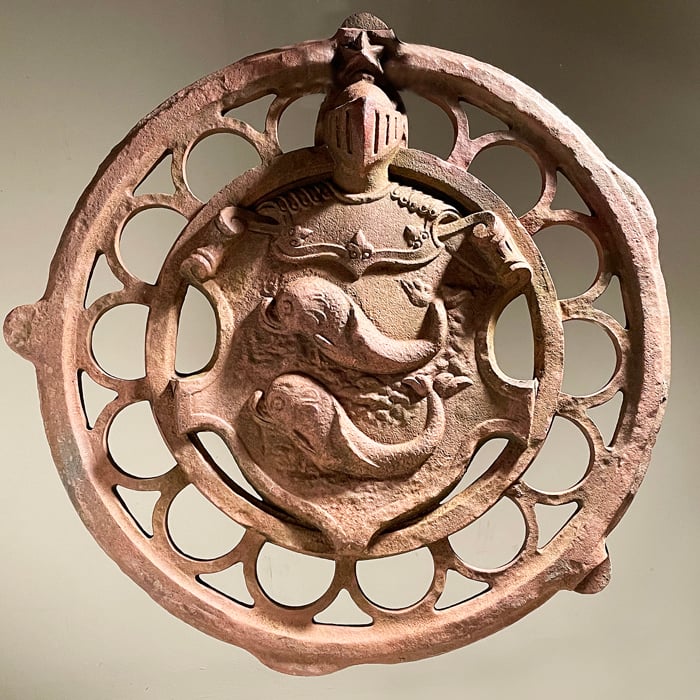
A large Victorian cast iron architectural roundel
$ 97.06
- Whilst most might assume that this roundel comes from either of the famous piers, we suspect this roundel originated from Brighton Railway station. It matches those still found in the iron spandrels of the curved platform canopy, sheds that have undergone numerous phases of additions and alterations since they were built. This roundel was discovered in an overgrown garden of a house in the Brighton suburbs – extracted from the bushes where it had clearly been sitting for decades. It is in its original paint and is well preserved. The original railway station at Brighton was an elegant building in the Italianate style designed by architect David Mocatta (1806-82) a pupil of Sir John Soane. He was the London & Brighton Railway’s consulting architect. The station opened in 1840 as the terminus of the newly completed line from London. It was an awkward site – Mocatta’s design was tucked against a steep escarpment in order the terminus could, in time, serve the coastal railway lines which would follow – they could only enter the town at that elevation to meet the line from London. The earliest train sheds along the curved platforms were modest structures built of timber and iron. With the arrival of the railway Brighton boomed. As demand grew, Brighton station underwent significant enlargement, and more substantial iron-and-glass sheds were added. They echoed the original curve while creating a dramatic arched space over the platforms. These later expansions, dated 1882-3, designed by H. E. Wallis, somewhat overshadowed Mocatta’s elegant terminus building; a large porte coucher was also added to the southern facade meaning the Italianate building was all but swallowed up. The spandrels of the train-sheds were embellished with the double-sided roundels which can also be seen on the promenade and piers at the seafront. They may well have been cast by the “Patent Shaft and Axletree Company” of Wednesbury in the Midlands as it was they who made the supporting columns and ironwork for the new station canopy. It is remembered that they brought the ironwork in by rail and managed to erect the structure without interrupting a single scheduled train.