
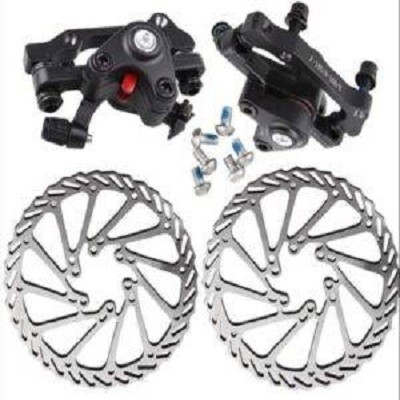
Bicycle Disk Brake
$ 4.71
- Bicycle Disc Brakes Explained Bicycle disc brakes are a type of braking system that uses a rotor (disc) attached to the wheel hub and calipers mounted on the frame or fork to slow or stop the wheels. They offer several advantages over traditional rim brakes, including: Superior stopping power: Disc brakes provide more powerful and consistent braking, especially in wet or muddy conditions, due to the rotor being isolated from the rim. Improved modulation: Disc brakes offer better control over braking force, allowing for smoother and more precise stops. Reduced rim wear: Unlike rim brakes, which wear down the rim over time, disc brakes don’t contact the rim, minimizing wear and tear. All-weather performance: Disc brakes are less affected by wet or muddy conditions, unlike rim brakes, which can lose stopping power when wet. Here are the key components of a bicycle disc brake system: Rotor: A metal disc attached to the wheel hub that spins with the wheel. Rotors come in various sizes (e.g., 160mm, 180mm) and materials (e.g., steel, stainless steel). Caliper: The housing that holds the brake pads and squeezes them against the rotor to slow or stop the wheel. Calipers can be mechanical (cable-actuated) or hydraulic (fluid-actuated). Brake pads: The consumable parts that make contact with the rotor to create friction and slow the wheel. Pads come in different materials (e.g., organic, semi-metallic, metallic) with varying characteristics like heat resistance and noise level. Lever: The handlebar-mounted lever that you squeeze to activate the brakes. Pulling the lever transmits force to the calipers, squeezing the pads against the rotor. Types of Bicycle Disc Brakes: There are two main types of bicycle disc brakes: Mechanical disc brakes: Use cables to transmit force from the lever to the calipers. They are generally more affordable but offer less stopping power and modulation compared to hydraulic brakes. Hydraulic disc brakes: Use fluid-filled lines to transmit force from the lever to the calipers. They offer more powerful and consistent braking, especially in demanding conditions. Choosing the Right Disc Brakes: When choosing disc brakes for your bike, consider factors like: Your riding style: If you do a lot of aggressive riding or descend steep hills, hydraulic brakes might be a better choice for their superior stopping power. Your budget: Hydraulic brakes are generally more expensive than mechanical brakes. Your bike’s compatibility: Ensure the brakes you choose are compatible with your bike’s frame, fork, and wheels. INCLUDE PACKING 1X Bicycle Disk Brake 1 Nos (make sure not pair only single pcs set) Related SKU: PRA-RC-0981 Category: Mechanical Accessories Tag: break