
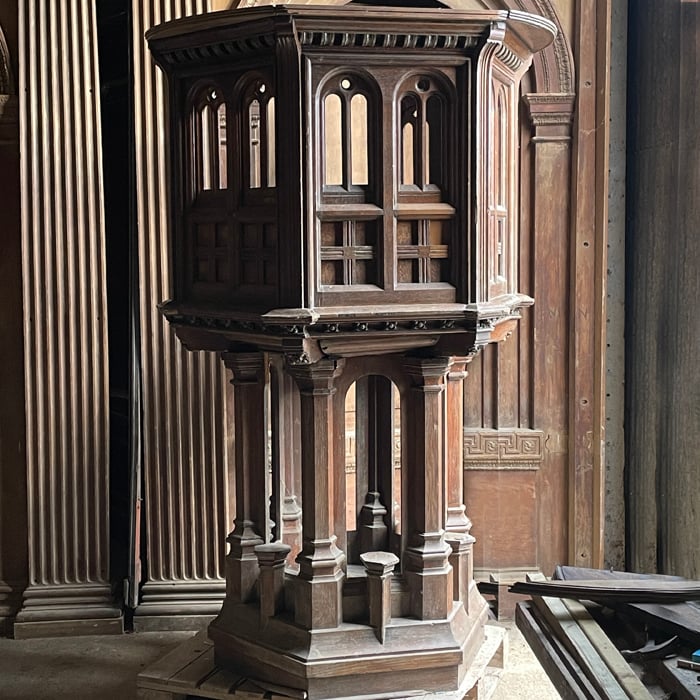
A Victorian carved oak pulpit
$ 92.50
- Alfred Waterhouse (1830–1905) was a prominent English architect of the Victorian era, best known for his mastery of the Gothic Revival style and his significant influence on public and institutional architecture in 19th-century Britain. Born in Liverpool to a Quaker family, Waterhouse was educated at Grove House School and trained under architect Richard Lane in Manchester before establishing his own practice in 1854. His early success came with the design of Manchester Assize Courts (1859), a project that showcased his distinctive approach combining robust Gothic forms with practical functionality. This commission established his reputation and led to a prolific career designing civic buildings, universities, and commercial structures. One of Waterhouse’s most celebrated works is the Natural History Museum in South Kensington, London (completed 1881). The museum’s terracotta façade, Romanesque arches, and intricate ornamentation exemplify his attention to detail and innovative use of materials to resist the city’s pollution. Waterhouse was also a leading figure in university architecture. He designed buildings for institutions such as the University of Manchester, Balliol College, and Girton College, Cambridge—one of the first women’s colleges in the country. His designs balanced grandeur with practicality, reflecting both moral seriousness and the Victorian emphasis on progress and education. In 1888, Waterhouse was commissioned to design the new King’s Weigh House Chapel after the congregation’s original site near London Bridge was demolished for road widening. He created a striking new chapel on Duke Street, Mayfair. Completed in 1891, the design combined red brick and terracotta with intricate detailing, reflecting Waterhouse’s signature craftsmanship seen at the Natural History Museum and elsewhere. The building served as both a place of worship and a social hub, symbolizing Victorian Nonconformist confidence and the congregation’s enduring presence in central London. It now serves as the Ukrainian Church of Great Britain. In addition to his Gothic and Romanesque projects, Waterhouse worked in other styles, including Renaissance and Neo-Romanesque, demonstrating versatility and adaptability to client needs. He was equally adept at designing commercial buildings, notably the Prudential Assurance offices in London and across Britain, which featured his trademark red brick and terracotta detailing. Elected President of the Royal Institute of British Architects (RIBA) in 1888, Waterhouse was highly respected by his peers. His legacy lies in his ability to blend aesthetic richness with structural integrity, shaping the architectural character of Victorian Britain. He is considered “The Architect’s Architect”.